Tuesday, November 16, 2010

Opening of Waterfront Post Office

The Mauritius Post issued a Special Cover on January 25 2006 to mark the re-opening of the ex-General Post Office under the new name of Waterfront Post Office.

The cover, affixed with two stamps of Rs2 and Rs7 denominations of the Postal Services series cancelled with the Waterfront P.O. postmark, portrays the GPO building in a coloured stamp shape.


Here is a photo of the Post Office...


... which provides usual postal services...


... and internet facilities too.

Monday, November 15, 2010

New Cover from France


Thank you David for this nice cover sent on 22 September from Dijon!  This mail, franked with a stamp issued by La Poste to mark the 2010 World Expo of Shanghai and two specimens of the 'Marianne' stamps of Beaujard, took only 3 days to reach my address!

Sunday, November 14, 2010

Mountains of Mauritius

The mountains of Mauritius are what remain of the immense volcanoes whose summits have exploded or have been swallowed by abysses millions of years ago.  They are of relatively modest height and they command rather than attract attention because of their unusual shapes and often scraggy contours.  The appearance and location of some of the mountains have resulted in some quaint naming by discoverers and travellers giving free rein to their imagination.


The highest mountain of the island is the Piton de la Petite Rivière Noire which stands at 828 metres high.

Rs2 - Le Pouce
Clench your fist with the thumb raised and its upper outline is exactly that of the Pouce Mountain as seen from Port Louis.  The thumb of this petrified giant's hand points to the sky in the Moka Range.  It is very popular amongst hikers and it can be climbed to its highest point of 811 metres from Port Louis, Moka and Saint Pierre.

Rs7 - Corps de Garde
The Corps de Garde Mountain resembles a figure with an impressive nose lying down...on sentry duty.  It is solidly bulky and overlooks Quatre Bornes and Rose Hill.  On a clear dawn the rays of the rising sun reflects a rosy hue on the basaltic rockface, hence, the origin of the name of the town of Rose Hill...

Rs8 - Le Chat et La Souris
The peak of Le Chat et La Souris as the name conjures, bears a strange resemblance to a cat subjugating a rat.  It is found in Grand Port Range in the east of Mauritius.

Rs25 - Piton du Milieu
The Piton du Milieu as the name implies simply squats, screwed down firmly, in the centre of the country.  It is striking although not a particularly high finger-like rock of 589 metres located about 7 km east of Curepipe.

The FDC illustrates a map of Mauritius showing the location of the mountains.

Saturday, November 13, 2010

Summer Olympic Games Beijing 2008

The Games of the XXIX Olympiad were a major multi-sport event that took place in Beijing, China from August 8 to August 24 2008.


Mauritius won its first Olympic medal ever (bronze medal), secured by Bruno Julie in the bantamweight boxing semifinals.

The China National Philatelic Corporation also released a booklet to mark this event.  It portrays the Emblem of the Games 'Dancing Beijing'...


... and the mascots of the 2008 Summer Olympics:  Beibei, Jingjing, Huanghuang, Yinyin, Nini.


The mascots illustrate the 4 most popular animals of China - the Fish, the Panda, the Tibetan Antilope, the Swallow - and the Olympic flame.

Friday, November 12, 2010

Achievements in the 20th Century

The Mauritius Postal Services issued a set of 4 commemorative stamps on 7th December 1999 to highlight the main achievements of Mauritius during the 20th century.


The stamps denominations are as follows:
R1 - Eradication of malaria, a deadly disease transmitted by the Anopheline mosquito,

Rs2 - Emancipation of women,

Rs5 - Construction of the International Conference Centre at Grand Bay,

Rs9 - Manufacture of special sugars, used mainly in bakery.

Thursday, November 11, 2010

My First Postcard from China


Wang sent me this nice cover from Shanghai on 25 September 2010.  The card portrays the Shanghai Pudong Development Bank.  The stamps at the verso are nice too! Thank you very much Wang :)

Wednesday, November 10, 2010

Mauritius c'est un plaisir!

The Mauritius Post Ltd issued on 9th October 2009 a set of 2 postage stamps to commemorate the launching of the new brand identity logo of Mauritius.


The logo has been inspired from the country's most valuable asset that exudes the brand values and personality: the spirit of the people of Mauritius.  It also reflects the spirit of the place.

In the 4 colours of the Mauritius national flag and in the same colour sequence, the logo appeals directly to the Mauritian.  The angular 'M' traces an outline of the Pieter Both Mountain with the rock settled on top revealing an intuitive and 'independent thinker'.  Recognisable amongst all, the Pieter Both Mountain is an icon itself in Mauritius - an emblem of the spirit of the place.  Its pointed style in both logo and reality displays intellectual qualities that include a vast curiosity and ever expanding horizons indicative of Mauritius.

If one looks more closely, the capital letter 'M' also appears as the image of a resting woman enjoying the beauty of Mauritius laid before her.

The letter 't' mirrors an iconic Mauritian person standing with widespread welcoming arms to demonstrate the spirit of the people, one that is warm and magnetising in personality.

The illustration on the FDC depicts a seal of quality that has been specially designed to be applied on packaging only.  In Mauritius, people have a sense of care in life that they transmit in their work.  This seal of quality is used by accredited manufacturers in Mauritius.

Tuesday, November 9, 2010

Les 70 ans de l'Appel du 18 Juin 1940 Célébrés


Le 18 juin 1940, le Général de Gaulle prononçait un discours sur les ondes de la BBC et dans lequel il appelle à ne pas cesser le combat contre l'Allemagne nazie.  Ce discours est considéré comme le texte fondateur de la Résistance française, dont il demeure le symbole.


A TOUS LES FRANÇAIS
   La France a perdu une bataille!
   Mais la France n’a pas perdu la guerre !
  Des gouvernants de rencontre ont pu capituler, cédant à la panique, oubliant l’honneur, livrant le pays à la servitude.  Cependant rien n’est perdu !
  Rien n’est perdu parce que cette guerre est une guerre mondiale.  Dans l’univers libre, des forces immenses n’ont pas encore donné.  Un jour, ces forces écraseront l’ennemi.  Il faut que la France, ce jour-là, soit présente à la victoire.  Alors elle retrouvera sa liberté et sa grandeur.  Tel est mon but, mon seul but !
  Voilà pourquoi je convie tous les Français, où qu’ils se trouvent, à s’unir à moi dans l’action, dans le sacrifice et dans l’espérance.
            Notre patrie est en péril de mort.
               Luttons tous pour la sauver !
VIVE LA FRANCE !
Général de Gaulle
18 juin 1940              Quartier-général,
                                4, Carlton Gardens
                                    London, S.W.I.
 Plusieurs timbres commémoratifs ont été émis par La Poste:
- un timbre de 20 centimes, pour le 20e anniversaire, émis le 20 juin 1960
- un timbre en 1964
- un timbre pour le 50e anniversaire en 1990
- un timbre pour le 70e anniversaire en 2010

Merci beaucoup Eric pour ce magnifique bloc-feuillet et aussi pour ce timbre personnalisé sur la pêche en mer. :)

Aujourd'hui 9 novembre 2010, on commémore le 40e anniversaire du décès du Général de Gaulle.  Hommage donc à ce grand homme!

Monday, November 8, 2010

Extinct Mauritian Giant Tortoises

The Mauritius Post Ltd issued on 16 July 2009 a set of 4 postage stamps depicting the extinct giant tortoises of Mauritius and Rodrigues.


The Mascarene Islands of Mauritius, Réunion and Rodrigues once harboured 5 species of giant tortoises, with 2 occurring on Mauritius and 2 on Rodrigues.  The name Cylindraspis actually means Cylinder-shaped.  They differed from any other giant tortoise species, with modified jaws, reduced scales on the legs and shells averaging 1 mm thick.  The need for protective armour was no longer required because of the absence of predators on the islands.  With the arrivals of humans in the 16th century and the subsequent introduction of domestic animals, especially pigs, the tortoises were rapidly hunted to extinction.

Rs5 - Cylindraspis peltastes (Rodrigues Domed Tortoise)
The difference in the shell shape of the Rodrigues giant tortoises is a result of different feeding strategies.  The smaller domed tortoise was a grazer, feeding on low vegetation, and lacked the distinctive saddle found in the larger species.  This provided an opportunity for the 2 species to coexist.  Rodrigues populations of giant tortoises were the largest on earth and early accounts report that the hills appeared to be paved by their shells.

Rs10 - Cylindraspis vosmaeri (Rodrigues Saddleback)
The saddleback tortoises had really long, flexible necks, much more than any other giant tortoise.  The upturned saddle in the shell was an adaptation to maximise the stretching of the neck.  As they could reach up to 1.4 metres to browse on low trees and shrubs, many Mascarenes plant species have developped a defence strategy called heterophylly, where low-lying juvenile foliage is a different shape from the adult leaves.  The tortoises do not recognise the juvenile leaves as food.


Rs15 - Cylindraspis inepta (Mauritius Domed Tortoise)
Early accounts suggest tortoises were laying their eggs in sand or soil near beaches.  They buried their eggs before abandoning them and relied on heat from the sun to incubate the eggs.  This made them very vulnerable to introduced predators.  The Mauritius domed tortoise was much larger than its Rodrigues counterpart and had an unusual extension to the back of the shell.

Rs25 - Cylindraspis triserrata (Mauritius Saddleback)
The shells of the giant tortoises were open-ended.  This was a specific adaptation in response to the lack of predators, where thick, heavily armoured shells were no longer necessary.  Unfortunately, the thin shells were of no protection against human colonists and mariners, and thousands were collected alive for provisioning ships.  Even more were boiled down for their valuable oil, which provided a cure for many ailments including scurvy.


Rs50 - Cylindraspis peltastes - Rodrigues Domed Tortoise
The Mauritius Post Ltd also issued, besides the 4 postage stamps, a miniature sheet showing a reconstruction of the Rodrigues Domed Tortoise and the Rodrigues Saddleback together with Rodrigues Blue Rail Erythromachus leguati .  The extinct blue rail, a bird known from historical accounts to feed on tortoise eggs, also probably followed the tortoises, feeding on disturbed insects and plucking parasites from their skins.  The blue rail became extinct just 30 years after being considered common in 1726, probably due to the introduction of rats and cats.

Saturday, November 6, 2010

Nice Cover from China


This cover was sent from Wuhan, Hubei on September 19.  It took 16 days to reach its final destination.  The red stamp on the top right was issued in 2009 for the 2010 World Expo in Shanghai and it depicts the Chinese architectural evolution from 1904-1993.  Thank you Hai :)

Friday, November 5, 2010

Malaysian Aerograms


Thank you Khor for this aerogram sent from Ipoh on September 22.  The above one is about the numerous types of dances in Malaysia:  Malay dance, Chinese dance, Indian dance, Ngajat dance (Sarawak) and Sumazau dance (Sabah).

The performing arts is a colourful way in which Malaysians of various races and cultures preserve their rich heritage.  The richness and unity prevailing in multi racial Malaysia is portrayed to the world with touches of Malay, Chinese and Indian culture as well as the varied cultures evident among the ethnic groups of Sabah and Sarawak.  Culture is an essential component in fashioning our nation for the future.


Khor also sent me this second aerogram  on the same day.  It portrays students expressing their patriotism to Malaysia, with one of them cheerfully holding the Malaysian flag.  Thank you again Khor!

Thursday, November 4, 2010

Indigenous Flowers of Mauritius Definitive Issue

The Mauritius Post Ltd issued on 9th April 2009 a set of 12 definitive stamps on the theme Indigenous flowers of Mauritius.  Even though the title of this set includes the word 'indigenous', some of the stamps feature endemic species. The small size and isolation of Mauritius have enabled its biodiversity to develop unique characteristics and a high level of endemism through thousands of years of evolution.


The various flowers illustrated on the stamps are as follows:

Rs3 - Myonima obovata


Small shrub of mid altitude dry forests, which bears nice clusters of small pinkish white flowers.  The beauty of this plant lies in its juvenile leaves where a mosaic of red, purple and green venation under a thin waxy layer catches one's attention.

Rs4 - Cylindrocline lorencei


Short endemic shrub with pinkish composite flowers confined to only one region in the wild at Plaine Champagne.  It has been positively cultured at Brest University in France and nursed at Kew Garden.  Young successful generations have been sent to Mauritius for local habitat adaptation.

Rs5 - Crinum mauritianum


Endemic lily plant rediscovered in the 1970's in the region of Midlands, it is now extremely rare since its habitat has given way to development project.  It bears beautiful white flowers throughout the year.

Rs6 - Elaeocarpus bojeri


Short endemic tree now confined to only 3 individuals at Grand Bassin Peak which bears long drooping inflorescence with bell-shaped whitish flowers.  Its regeneration by seeds is almost negligible.  Successful attempts have been obtained from layering and grafting techniques.

Rs7 - Bremeria landia


Small indigenous tree of upland humid forest which bears bright white flowers at its branch tips.  This plant is also used by local people for medicinal purposes against fever and as a tonic drink.

Rs8 - Distephanus populifolius


Rare endemic plant found only on dry exposed mountain tops where it grows on rocky medium.  It bears composite white and yellow flowers and its silvery leaves offer a perfect camouflage with its rocky surroundings.

Rs9 - Gaertnera longifolia var. Longifolia


Endemic rare short tree thriving in upland humid forests.  It can easily be recognized by its long leaves and its terminal white inflorescence.  It remains one of the rarest Gaertnera species of the island.

Rs10 - Dombeya acutangula var. rosea


Rare plant found in the wild on few mountain flanks.  It is also one of the native flowering plants commonly planted in gardens and used in landscaping projects.  This plant bears conspicuous pink inflorescence.

Rs15 - Aphloia theiformis


Indigenous plant with various medicinal virtues, among which diuretic. It was also used extensively against malaria and it is quite common in upland humid forests and bears tiny white flowers at the base of the leaves.

Rs22 - Barleria observatrix


Endemic shrub now confined to only Corps de Garde Mountain.  It bears nice small purple flowers which are one of the most beautiful wild flowers of the island.

Rs25 - Roussea simplex


Rare endemic shrub now found in few places like Le Pouce, Grand Bassin, Bassin Blanc, Trou aux Cerfs and Combo.  Its orange yellow bell-shaped flowers are conspicuous and attractive.

Rs50 - Hibiscus fragilis


Rare endemic shrub with rambling branches striving only on two mountains of Mauritius: Corps de Garde and Le Morne Brabant.  It bears deep carmine striking flowers.


The first FDC (denominations: Rs3, Rs6, Rs7, Rs50) features the Ochna mauritiana.


The second (denominations: Rs4, Rs8, Rs15, Rs22) portrays the Gagnebina pterocarpa.


Finally the third FDC (denominations: Rs5, Rs 9, Rs10, Rs25) represents the Cordemoya integrifolia.


This post was updated with new scans on 8 August 2016.

Wednesday, November 3, 2010

Splendid Cover from Taiwan!


I was very glad to receive this nice letter posted from Taipei on September 20 2010.  There are 4 beautiful stamps, issued in 2010, affixed on it, all depicting traditonal buildings of Taiwan.  Thank you James for this nice sending! :-)


Tuesday, November 2, 2010

Cover from Spain...


Thanks Emilio for your cover.  It's my first one from your country! ^^

FIFA World Cup South Africa 2010

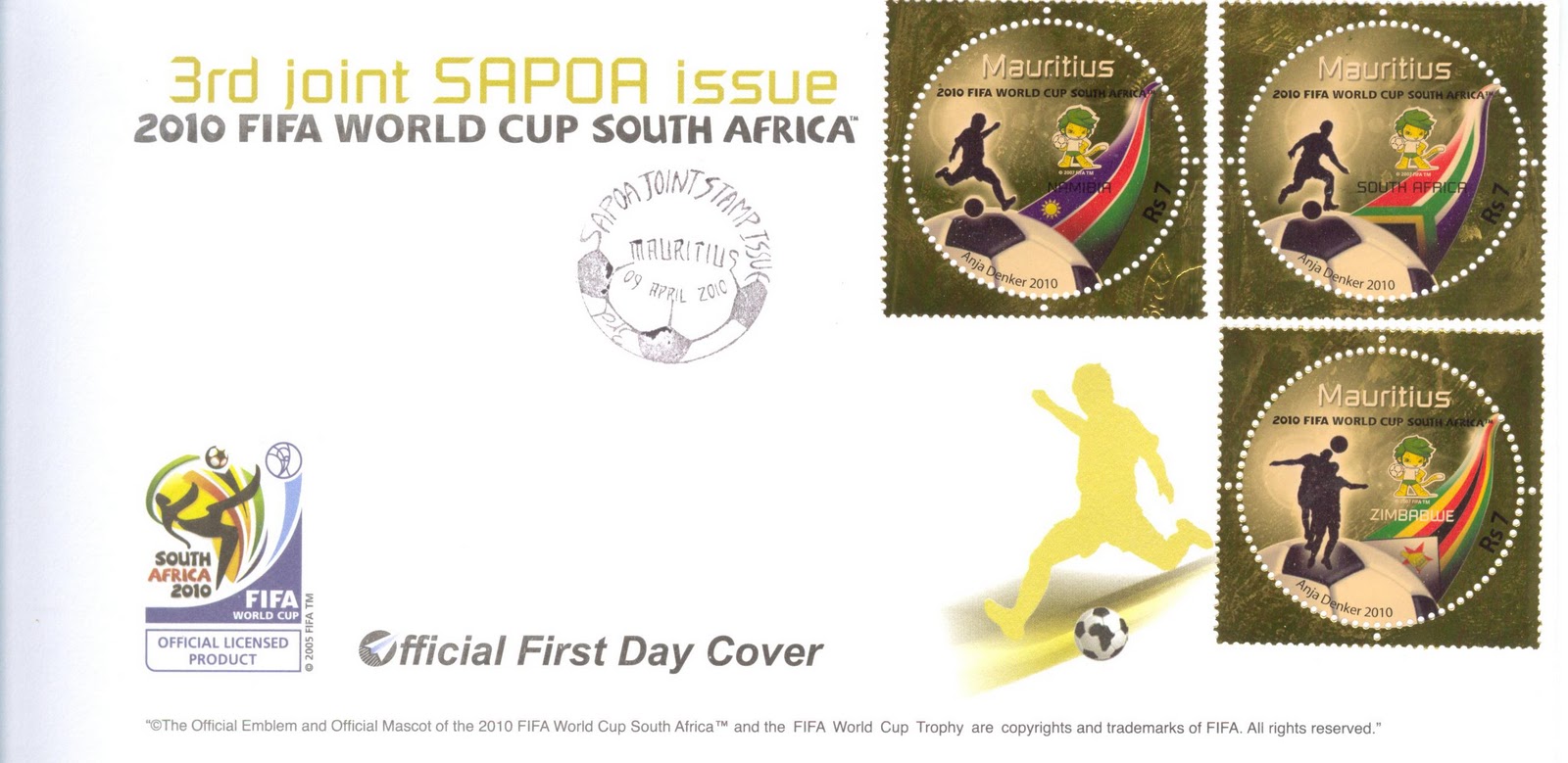
South Africa hosted, from June 11 to July 11 2010,  the XIXth edition of the FIFA World Cup.  Nine countries, out of the fourteen of the Southern Africa Postal Operators Association (SAPOA), marked this historical event (it was the first time the African Continent was hosting the FIFA World Cup) by a joint issue.


The Mauritius Post Ltd issued, on 9th April 2010 a set of 3 First Day Covers, with three stamps affixed on each, illustrating the national flag of each country.


The design of the stamp features a graphic image of soccer players in action, a soccer ball, the national flag of each country and last but not least: Zakumi - the official mascot especially designed for the World Cup in South Africa.  The name 'Zakumi' is a composition of 'Za' standing for South Africa and 'kumi', which means '10' in various languages across Africa.


The Mauritius Post Ltd also released a gold foil souvenir sheet consisting of nine postage stamps of Rs7, representing the nine issuing SAPOA countries.


The nine participating countries are as follows:
Botswana, Lesotho, Malawi, Mauritius, Namibia, South Africa, Swaziland, Zambia and Zimbabwe.


Monday, November 1, 2010

First Youth Olympic Games in Singapore...


Singapore hosted, from 14-26 August 2010, the first Youth Olympic Games (YOG).  170 countries, including Mauritius, participated in this international event which features athletes aged between 14 and 18.  The Games were officially opened by the President of Singapore: S. R. Nathan, and its motto Blazing the trail.
Terence kindly sent me this nice cover from the Youth Olymoic Village (YOV) on August 26 (the closing day of the Games).  Both stamps portray the mascots of the Games Lyo and Merly, a fire-themed lion and a water-themed female merlion respectively.  Thank you very much Terence!

Mauritius in World Literature


Here is one of the most beautiful set of stamps ever issued in Mauritius!  The Mauritius Post Ltd issued this set of 5 postage stamps on 8th December 2008 to highlight the presence of Mauritius in World Literature.  Five of the world's renown novelists who wrote on or visited the island between the 18th and 19th centuries have been portrayed, namely:

Rs5 - Bernardin de Saint Pierre (1737-1814)

Jacques Henri Bernardin de Saint Pierre is a renown author and novelist of 18th century France for his novel Paul et Virginie which he wrote in 1789 having been inspired by the enchanting environment of Isle de France (Mauritius) during his stay in 1768. 

Rs10 - Alexandre Dumas (1802-1870)

Alexandre Dumas (Davy de la Pailleterie) père, one of the world's most versatile writers and novelists, of mixed origin, his father of French nationality and his mother of African slave ancestry, is a gifted genius with a prolific style and author of a series of novels depicting the French heroic times.  His novel Georges (le mulâtre) published in 1843 has for background Mauritius.


Rs15 - Charles Baudelaire (1821-1867)

Charles Baudelaire is one of the most prolific writers and poets of 19th century France.  On hids way to India, his sailing vessel stopped over in Port Louis in September 1841, he found the island and its inhabitants awe-inspiring and wrote a sonnet for a charming lady, entitled A une Dame Créole.

Rs22 - Mark Twain (1835-1910)

Samuel Langhorne Clemens better known by his pen name Mark Twain born in Florida on the 30th Novembr 1835 is one f the most important figures in American literature and one of th greatest humorists.  Through his humour and his shrewd power of observation, he immortalised 19th century life.

The author of Tom Sawyer, came in Mauritius in 1896.  In his book entitled More Tramps Abroad or Following the Equator xpublished in 1897, he wrote "... you gather the idea that Mauritius was made first and then heaven and that heaven was copied after Mauritius".
(It should be noted however that this phrase was taken out of its context)

Rs25 - Joseph Conrad (1857-1924)

Joseph Conrad is one of the most famous British novelists of polish origin of his true name Teodor Josef Konrad Korzeniowski.  He started his career as a sailor in the French Navy, as such made a stop over in Port Louis for 2 months and 1888 where he fell in love with a Mauritian girl who refused him marriage.  He was for long considered as the greatest living novelist.  His tale A Smile of Fortune was inspired by his visit to Mauritius which he described as "a pearl distilling sweetness upon the world".

Nice One from Belgium...


This special enveloppe was sent from Belgium on 11th August 2010 and reached Mauritius on August 17.  But what is more interesting is what is inside...

The set of 5 stamps on the left represents traditional games.  The 2 stamps in the middle were issued for the Journée du Timbre 1967 and 1966.  They both illustrate postmen delivering their mail.  Finally, the stamp on the far right portrays Paul-Emile Janson (1872-1944), a Belgian liberal politician who served as the 30th Prime Minister of Belgium in 1937-1938.
Thank you Thomas! ;-)