Sunday, July 19, 2015

Closing of Belle Rose Post Office & Opening of Trianon Post Office

The Mauritius Post released on 6 October 2014 a Special Envelope to mark the closing of Belle Rose Post Office (PO) and the opening of a new Post Office at the Trianon Shopping Park.


Belle Rose PO opened on 16 March 1948. Belle Rose is a locality in the city of Quatre Bornes and is stuck between the city of Rose Hill, the recently-founded cybercity of Ebène and another small locality, Trianon.

Priority mail sent from Belle Rose PO on 8 February 2005
Mail registered on 14 July 2008 with Advice of Delivery (AR)


Mail registered on 24 May 2013...
...with barely legible datestamp
Mail registered on 22 August 2014 with illegible datestamp.

The Belle Rose Type D circular datestamp was visibly in a very poor state and clearly needed some well-deserved rest...

Following the closing of Belle Rose PO on 4 August 2014, all postal and non-postal services were transferred to the new Trianon PO which opened to the public on 6 October 2014.

Belle Rose must not be confused with Rose Belle which is a village in the south-east of Mauritius.

Mail registered on 12 July 2013 at Rose Belle PO

Official inauguration of the Trianon PO was held on 9 October 2014, World Post Day, in the presence of Tassarajen Pillay Chedumbrum, the then Minister of Information and Communication Technology, Arnaud Godère, the then Chairman of the Mauritius Post, and Giandev Moteea, the Chief Executive Officer of the Mauritius Post.


Commercial mail registered at the Trianon PO on 13 November 2014

Circular Type D datestamp of the Trianon PO with 'S.P' standing for 'Shopping Park'. Observant philatelists would have noticed the missing dot after the 'P'


The Trianon PO is the first one to be opened in a shopping mall in Mauritius.

Many Postal Agencies (PAs) used to operate in grocery shops (locally known as 'la boutik') such as Henrietta PA at a general store and La Louise PA at a bakery since 1969 until their closing on  17 August 2011 and in December 2012 respectively.

Albion PA currently operates in a supermarket.

Technical Details


Release date: 6 October 2014
Stamps: stamp-style pictures of Belle Rose PO (left) and Trianon PO (right)

Saturday, July 18, 2015

150th Anniversary of the Death of Blessed Father Laval

The Roman Catholic Church of Mauritius in collaboration with the Mauritius Post released on 9 September 2014 a Special Commemorative Cover (SCC) to mark the 150th death anniversary of Blessed Father Laval.

SCC with Sainte Croix PO datestamp and Father Hym, vicar of the Parish of Sainte Croix's, signature

Born in 1803 in Croth (Eure), Normandy, France, Jacques Désiré Laval or 'Lal', as he nicknamed himself, had announced at the age of 7 that he would be either priest or doctor.  From 1830 till 1835, he was doctor in Normandy, and even thought about getting married.  But God's call would prove stronger.

His dream was to become missionary in China, but in 1838, he became priest and practised for two years in Pinterville.

However Father Laval wanted to serve the poor. He boarded the Tanjore in London on 2 June 1841 and arrived in Port Louis on 14 September 1841, as the first Spiritan in Mauritius. During his 23 years at the service of the Mauritian people, he succeeds in evangelising the former slaves by turning them into the Catechists of their brothers, and of their former masters too.

On 9 September 1864, at the age of 61,  Father Laval passed away, exhausted; a procession of 40,000 people carried his coffin to Sainte Croix ('Holy Cross' in English) where he chose to be buried.  2014 marked the 150 years of Father Laval's passing away; a Rs8 stamp was issued to mark this milestone.

He is recognised as the Apostle of the unity of all Mauritians ("L'Apôtre de l'unité de tous les Mauriciens"). 150 years after his death, accounts of gratitude for physical, moral, spiritual and relational recoveries still come in from all parts of the island and abroad.

Leaflet in French with plans of the new and modern shrine and bank details for donations


Mauritians of all religions and social classes flock to Father Laval's shrine all year round to confide their hopes and sorrows, their ups and downs to him.


150 ans benediksyon pou nou pei (150 years of blessing for our country)


On 30 April 1979, to commemorate the beatification by Pope John Paul II of Father Laval, Mauritius issued three postage stamps and a souvenir sheet.

"May this stamp remind us that whenever we doubt our Mauritianism (Mauricianisme in French), whenever we believe that our differences divide us instead of enriching us mutually, let us turn to Father Laval and we shall find the courage to believe that it is possible to build a future for our children, a future of peace and fraternity."

"Pour ce que vous êtes, pour ce que vous continuerez à être pour tout un peuple,
Merci Bienheureux Père Laval!"

'For what you are, for what you will keep on being for a whole people,
Thank You Blessed Father Laval!'

N.B.: The above text is adapted from the SCC insert and is translated from French.

Technical Details


Release date: 9 September 2014
Stamp: Rs8 - 150th Death Anniversary of Bienheureux Père Laval
            From the 'Anniversaries and Events' issue of 28 May 2014.

A collection of maxicards:

Hand stamped at Sainte Croix:

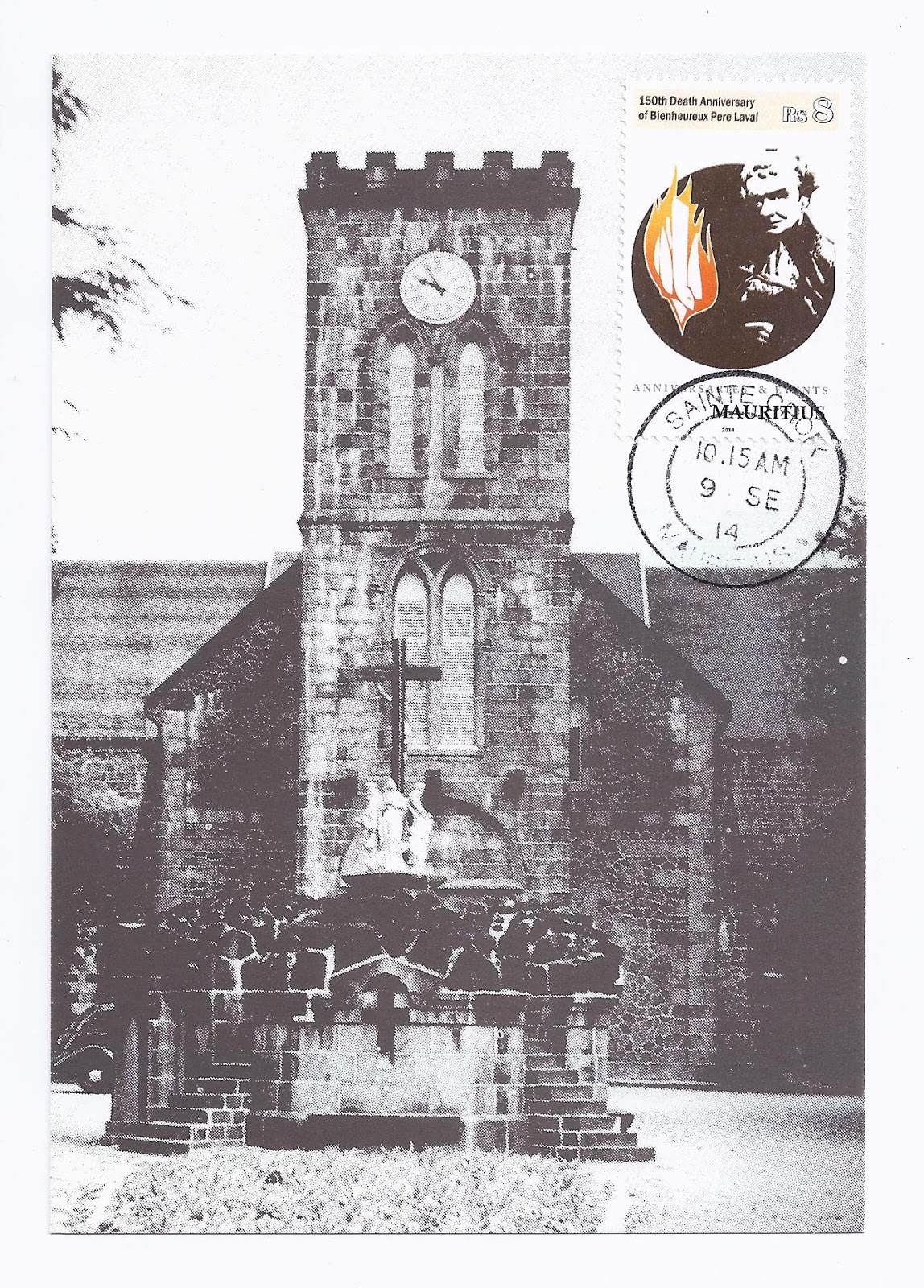
Painting of Father Laval exposed at St. Peter's Basilica during his beatification in April 1979; today in Sainte Croix church.


Former vault of Father Laval, erected in 1870, demolished in 1964.

Old Sainte Croix church destroyed by cyclone Carol in 1960.

Pope John Paul II praying at Father Laval's shrine on 15 October 1989 during his visit to Mauritius.


Hand stamped at the Philatelic Bureau, Port Louis:


New Sainte Croix church, at the end of a mass


Thursday, July 16, 2015

90th Anniversary of the Cooperative Movement in Rodrigues (1924-2014)

The Mauritius Post released on 8 August 2014 a Special Commemorative Cover to mark the 90th anniversary of the cooperative movement in Rodrigues.


On 8 August 1924, Rodrigues witnessed the registration of the first cooperative society known as the Trèfles Cooperative Credit Society Ltd.

From statistics available as at June 2013, 70 cooperative societies were registered  in Rodrigues. The number of members of cooperative societies has reached the figure of 10,598. The percentage of the Rodriguan population grouped in cooperatives is around 25%. Altogether the cooperative sector in Rodrigues has a turnover of Rs 157M.

At the end of the 1950s, a Consumer Cooperative Store Society was set up in Port Mathurin to provide for a wide range of domestic commodities at competitive prices to its members.

Thereafter, in the early 1960s, a group of inhabitants of Saint Gabriel formed the Saint Gabriel Cooperative Stores Society Ltd. The Mauritius Consumers Cooperative Federation Ltd. was entrusted with the management of the Saint Gabriel Cooperative Stores Society Ltd. in 2007.

In 1967, the Rodrigues Agricultural Production and Marketing Cooperative Society (RAPMCS) was registered. Since its inception, it acted as the Agent of the Agricultural Marketing Board for the purchase of onions and garlics from planters of the island and shipped the produce to Mauritius.

Afterwards, in the early 1970s, five Regional Agricultural Credit and Marketing Cooperative Societies were established to decentralise the activities of the RAPMCS. In 1992, the Rodrigues Agricultural Marketing and Cooperative Federation Ltd. (RAMCF) was formed by the Regional Agricultural and Marketing Cooperative Societies to replace the RAMPCS.

Five Livestock Cooperative Societies joined to form the 'Fédération des Associations Coopératives des Eleveurs de Rodrigues Ltée.' (FACER - Federation of Cooperative Associations of Farmers of Rodrigues Ltd.). It operates at the 'Maison des Eleveurs et Agriculteurs' (Farmers' House) since its registration in 1987 and runs five distribution centres for the sale of animal feed, veterinary supply and so on. Equally, it coordinates the marketing of live animals for export to Mauritius.

The Rodrigues Fishermen's Cooperative Society Ltd. was the first fishermen's cooperative society established in the 1970s.

In 1985, six Large Net Fishermen's Cooperative societies joined to set up the Rodrigues Fishermen's Cooperative Federation Ltd. which was entrusted with the management of the 'Maison des Pêcheurs' (Fishermen's House). With a view to embarking on off-lagoon fishing, five new fishermen cooperative societies were registered in 2009.

The first food-processing cooperative society in Rodrigues was set up in 1996. Presently, there are seven food-processing and marketing cooperative societies in Rodrigues. They have been formed mainly by women entrepreneurs. A Cooperative Federation for Agro food-processing has also been registered on 26 August 2013 under the appellation of 'AGROD Cooperative Federation Ltd.'

The Cooperative Credit Societies have been a great pillar of the small economy of the island. They have enabled their members (mainly farmers) to mobilise savings from which loans at a reasonable rate were granted for crops cultivation and animal rearing. These cooperatives have contributed significantly towards the improvement of the standard of living of many Rodriguans.

The financial sector comprises four Cooperative Credit Unions, namely: the Rodrigues Northern, United Development, Nassola and Rodrigues Women as well as the 'Association Coopérative des Caisses Villageoises Lévé Débouté de Rodrigues' (Cooperative Association of Get Up Stand Up Villagers' Funds of Rodrigues). The latter has more than 60 branches throughout Rodrigues.

The members obtain financial support from these societies by way of loans at reasonable rate of interest for provident and productive purposes.

The agricultural sector in Rodrigues has been very prominent in the cooperatives sector. It is expected that with time other sectors, namely the food-processing and the tourism sectors, which are already predominant in Rodrigues, would bring their share.

N.B.: The above text is from the SCC insert.


Technical Details


Release date: 8 August 2014
Stamp: Rs11 - 250th Anniversary of the Observation of the Transit of Venus from Rodrigues (1761-2011)
             From the 'International Commemorative Events' issue of 8 September 2011.

Wednesday, July 15, 2015

50th Anniversary of the Mauritius Broadcasting Corporation (1964-2014)

The Mauritius Broadcasting Corporation (MBC) in collaboration with the Mauritius Post released on 8 June 2014 a Special Commemorative Cover to mark their 50th anniversary.


The MBC is the national public broadcaster of the Republic of Mauritius, i.e. the islands of Mauritius, Rodrigues and Agaléga. It was established a a body corporate under Act No.7 of 1964, and operates under the aegis of the Prime Minister's Office.

The headquarters of the MBC was traditionally at 1, Louis Pasteur Street, Forest Side, Curepipe until all staffs and equipments were moved in 2011 to new headquarters in Moka.  The MBC also operates a station in Rodrigues.

The MBC programmes are broadcast in 12 languages, namely: French, Mauritian Creole, English, Hindi, Urdu, Bhojpuri, Tamil, Telegu, Marathi, Gujrati, Mandarin/ Cantonese and Hakka; it provides 17 television channels in Mauritius, 4 in Rodrigues and 2 in Agaléga and 7 radio channels.

Source: Wikipedia


On 17 June 2015, the MBC switched all of its channels from analogue mode ("mode analogique" in French) to digital mode ("mode numérique" in French).


Leaflet in Mauritian Creole and in French on how to switch from analogue to digital

The website of the Mauritius Broadcasting Corporation: http://mbc.intnet.mu/mbc/homepage


Technical Details

Release date: 8 June 2014
Stamp: Rs6 - Wind Energy (Maurice Ile Durable)
            From the 'Anniversaries & Events' issue of 30 May 2013

Tuesday, July 14, 2015

25th Anniversary of the Introduction of Mobile Telephony in Mauritius by Emtel (1989-2014)

Emtel in collaboration with the Mauritius Post released on 29 May 2014 a Special Commemorative Cover to mark 25 years of mobile telephony in Mauritius.


Following the first cellular service in September 1983 in the United States, Emtel, an international joint venture between Currimjee Jeewanjee & Co. Ltd., based in Mauritius, and Millicom International Cellular S.A., based in Luxembourg, became on May 29, 1989, the first cellular operator in Mauritius and the whole Southern Hemisphere.

Emtel Headquarters are in the cybercity of Ebène.

Cellular communication has played a vital role in the socio-economic and cultural development of Mauritius, by connecting the mainland to the outer islands of Rodrigues and Agaléga for instance.

There are currently around 1.5 million cellular subscribers in Mauritius (accurate as at May 2014) for a population of 1.3 million inhabitants (2014 estimate).


The list of Emtel milestones: https://www.emtel.com/corporate-information

Emtel website: https://www.emtel.com/

Technical Details

Release date: 29 May 2014
Stamp: Rs25 - 25 Years of the Introduction of Mobile Telephone in Mauritius
            From the 'Anniversaries & Events' issue of 28 May 2014

This Special Cover was a private issue.

Monday, July 13, 2015

Anniversaries & Events 2014

The Mauritius Post issued on 28 May 2014 a set of four stamps on the theme 'Anniversaries & Events'.


Rs8 - 150th Death Anniversary of Blessed Father Laval (1864-2014)


Father  Jacques Désiré Laval (1803-1864) - 'Père Laval' in French and Mauritian Creole - left his parish of Pinterville in Normandy, France and arrived in Port Louis on 14 September 1841.

Given his sense of devotion to duty and his humane approach, the then Bishop of Port Louis, Allan Collier, conferred upon him the mission of catechisation of the population of former slaves. There were around 67,000 of them, whom he found in absolute poverty and totally illiterate. Moreover, most of them had hardly been baptised.

For 23 years, he consecrated his whole mission in Mauritius to the cause of the most needy among them. It is thanks to his relentless effort that the descendants of African and Malagasy slaves were converted to Catholicism.

At the age of 61 through relentless hard work he was broken in health.  'L'Apôtre des noirs' ('The Apostle of the Blacks' in English) as he became known, passed away on 9 September 1864. His death was deeply mourned by the whole population. His funeral was attended by a huge crowd estimated at 40,000 who took his coffin from Saint Louis Cathedral in the centre of Port Lois to Sainte Croix,  a distance of 5 km on the outskirts of the city, for burial. His vault has now become one of the most renowned places of worship in Mauritius.

For the past 150 years, on the night of 8 September each year, people from all walks of life and hailing from every corner of the island and even from abroad, come to his sepulture in Sainte Croix in rememberance of his love and strong dedication for the poor and the down-trodden and in quest for salvation.

In virtue of a decree on  22 June 1972, Pope Paul VI proclaimed that Father Laval had practised christian virtues to a heroic degree. At a formal ceremony held in Rome on April 24, 1979, Father Laval was beatified by Pope John Paul II and is now known as the Blessed Father Laval ("Bienheureux Père Laval" in French), pending his canonisation.

Rs14 - 10th Anniversary of the Creation of the Ombudsperson for Children's Office


The Office of the Ombudsperson for Children was set up on 10 December 2003 pursuant to the Ombudsperson for Children's Act 2003. Mrs. Shirin Aumeeruddy-Cziffra was the first Ombudsperson for Children. The first of its kind in Africa, the Ombudsperson for Children has the statutory duty to:

a) ensure that the rights, needs and interests of children are given full consideration by public bodies, private authorities, individuals and association of individuals;

b) promote the rights and best interests of children;

c) promote compliance with the Convention.

It investigates into cases of violation of the rights of children and advises the relevant authorities on legislations, policies and practices in the best interests of children.

Mrs. Rookmeenee Narainamah Narayen, former Judge of the Supreme Court, is the present Ombudsperson for Children. She took office on 10 December 2011.

Rs15 - 200th Anniversary of the Arrival of Reverend Jean Joseph Le Brun in Mauritius (1814-2014)


Reverend Jean Le Brun is regarded as the precursor of free education in Mauritius. Soon after his arrival on the island on 18 May 1814 he started setting up schools, the first one at Chaussée Street, Port Louis, on the site of 'Maison Mabille', for those who could not attend private schools on account of their limited resources and of class discrimination.

Reverend Jean Le Brun worked with determination for the emancipation of the coloured people, the liberated slaves and the indentured labourers who constituted the classes subject to discrimination. In 1826, he deposed before the Eastern Enquiry Commission, and on 22 June 1829 an order in council gave coloured people full legal rights.

Reverend Le Brun was the first protestant missionary to set foot on the island. As a missionary, he also set up churches in various parts of the island, preaching the Gospel and providing free education as well.  

Born on 7 September 1789 in Jersey, Channel Islands, Jean Le Brun passed away on 21 February 1865 in Port Louis, Mauritius, where he was buried in the Western Cemetery.

Rs25 - 25 Years of the Introduction of Mobile Telephone in Mauritius (1989-2014)


Mauritius takes pride in being one of the first countries in the southern hemisphere to have introduced mobile telephone.

In the wake of the first cellular service in September 1983 in the United States, a Mauritian private company, Emtel Ltd., the pioneer in the sector, successfully launched, in May 1989, the first mobile telephone in Mauritius. Thereafter, other telecommunication operators followed suit.

Improved technology has enabled migration from basic telephony to an array of facilities for the users ranging from SMS, MMS, e-mails, wireless connectivity and all sorts of mobile applications are being developed for a variety of services. This increased connectivity has fundamentally transformed the Mauritian society.

Cellular communication has played a vital role in the socio-economic and cultural development of Mauritius, by connecting the outer islands of Rodrigues and Agaléga for instance.  In May 2014, there were around 1.5 million cellular subscribers in Mauritius.

Unofficial FDC registered at Port Louis GPO

Technical Details

Release date: 28 May 2014
Stamps Denominations & Illustrations: 
  Rs8 - 150th Death Anniversary of Bienheureux Père Laval
  Rs14 - 10th Anniversary of the Creation of the Ombudsperson fro Children's Office
  Rs15 - 200th Anniversary of the Arrival of Reverend Jean Joseph Le Brun in Mauritius
  Rs25 - 25 Years of the Introduction of Mobile Telephone in Mauritius
Design: Graphic Department (The Mauritius Post Ltd.)
Size:  29.94 mm x 44.45 mm
Printer: BDT International Security Printing Ltd.
Process: Lithography
Number per sheet: 50 stamps set in two panes of 25
Perforation gauge: 14 × 2 cm
Watermark: w18 - CASCO

Sunday, July 12, 2015

40 Years of the Maritime Wing of the Mauritius Police Force (1974-2014)

The Maritime Wing of the Mauritius Police Force - the National Coast Guard - in collaboration with the Mauritius Post released on 7 April 2014 a Special Commemorative Cover (SCC) to mark its 40th anniversary.


History of the Maritime Wing


1974: Genesis of the Maritime Wing - No.1 Patrol Vessel Squadron
INS Amar, an Abhay Class patrol vessel, was gifted from the Government of the Republic of India to the Government of Mauritius. The ship was commissioned as MNS Amar on April 3, 1974. She was later re-commissioned into service as CGS Amar on 24th July 1987. The Grand Old Lady was decommissioned on March 19, 1998.

1987: Mandovi Class Patrol Boats
Three 24-metre fibre glass Mandovi class vessels were inducted on July 24, 1987. CGV Barracuda and CGV Marlin were inducted in the National Coast Guard and one was used as Custom Launch. Subsequently, another three vessels of the type were inducted, namely: CGV Polaris, CGV Castor and CGV Sirius. These vessels retired from the service in late 1990s.

1990: Two Zhuk Class Patrol Boats - CG 81 & CG 82
Two Zhuks Class fast patrol ships gifted by the erstwhile USSR were commissioned on January 19, 1990 at Quay 'B'. The 24-metre fast patrol ships were christened CGS Rescuer and CGS Retriever. The ships were built in Feodesia, USSR. A soviet team of six people was tasked for undertaking the initial training of the Mauritian crew. During their six-month stay, they trained the Mauritian crew who took over the ship and have operated her since then. Both the Zhuks underwent successful re-engineering (westernisation) of their main propulsion and power generating plant in 2002 and 2009 respectively.


1993: CGS Guardian - CG 60
CGS Guardian, a Seaward Defence Boat (SDB) procured from India was commissioned on April 22, 1993. The ship is equipped with medium range weaponry and state of the art navigation and communication sensors and is capable of carrying out a wide variety of missions including Exclusive Economic Zone (EEZ) surveillance, anti-smuggling, search and rescue, anti-piracy patrol and outer island support. The ship has been the mainstay of the NCG for vital outer island support to Saint Brandon and sea training of personnel of No.1 Patrol Vessel Squadron.

1996: CGS Vigilant - CG 21
CGS Vigilant of 75 m overall length was commissioned on June 27, 1996, at Port Louis.  CGS Vigilant is an Offshore Patrol Vessel designed by the Western Canada Marine Group (WCMG) and built by ASMAR Shipyard, Talcahuano, Chile. The ship is fitted with a 40/56 Gun. CGS Vigilant is equipped with two reverse osmosis plant and has been tasked for EEZ Surveillance. The ship participated in 'International Fleet Review', Mumbai in 2001.

2001: CGS Observer - CG 71
The Interceptor boat christened CGS Observer was transferred on free lease to the Government of Mauritius from the Government of India in 2001. The boat was built in 1997 by Anderson Maritime Ltd. in India and was commissioned in Mauritius on April 21, 2001.


2014: CGS Barracuda - CG 31
The CGS Barracuda, 75 metres in length and can patrol 5,000 nautical miles at a speed of 20 knots will be operational by the end of 2014. Equipped with high technology and advanced systems of electronic navigation equipment, the OPV will be deployed in the exclusive economic zone for various monitoring missions, and will fight against piracy, illegal fishing and drug trafficking. The ship is constructed by Garden Reach Shipbuilders and Engineers Ltd. (GRSE) Kolkata, India.

N.B.: The above timeline is from the SCC insert.

Website of the National Coast Guard with some very interesting information: http://police.govmu.org/English/Organisation/Branches/Pages/National-Coast-Guard.aspx

Technical Details

Release date: 7 April 2014
Stamp: Rs7 - Regattas
            From the 'Bicentenary of Mahebourg (1806-2006)' issue of 4 February 2006

Saturday, July 11, 2015

Celebrating International Women's Day 2015

The Ministry of Gender Equality, Child Development and Family Welfare in collaboration with the Mauritius Post issued on 8 March 2015 a Special Commemorative Cover to celebrate four decades (1975-2015) of advocacy for gender equality.


"The proclamation of the International Year of Women and the 8 March as International Women's Day by the United Nations in 1975 resulted in an era of advocacy for women's rights.

United Nations member states including Mauritius have since committed themselves to thrive for a world where equality and opportunity for all prevail.

After forty years of advocacy for equality between women and men, a quick glimpse reveals that women have made tremendous progress since the first International Women's Day.

Women have equal access to education, health services and employment; they have the right to vote and contest elections and women are now present in all spheres of society.

Yet women still face injustices.  They remain under-represented in high level decision-making instances; even worse, violence against women in various forms remains commonplace in our society.

Feminisation of poverty and unemployment are also challenges that women face. These are often associated to patriarchy which is still deeply embedded in our culture.

On the occasion of the International Women's Day 2015, I wish to seize this opportunity to urge the nation to act for change.

Greater sustained and urgent actions are needed to deal with all prevailing forms of discrimination against women.  We can and must do better because equality for women is progress for all."

Hon (Mrs.) Aurore Perraud,
Minister of Gender Equality, Child Development and Family Welfare


'Gender equality is my agenda'

Technical Details

Release date: 8 March 2015
Stamp: Rs10 - The Richly-Blooming Oeoniella Orchid (Oeoniella polystachys)
              From the 'Fauna & Flora' issue of 30 August 2013

Friday, July 10, 2015

Fauna and Flora 2014

The Mauritius Post issued on 28 March 2014 a set of three stamps on the theme 'Fauna and Flora'.


Rs7 - Dragon Fly (Anisoptera)


A dragonfly  is an insect belonging to the order Odonata, the suborder Epiprocta or, in the strict sense, the infraorder Anisoptera.  It is characterised by large multifaceted eyes, two pairs of strong transparent wings, and an elongated body.

Dragonflies can sometimes be mistaken for damselflies, which are morphologically similar; however, adults can be differentiated by the fact that the wings of most dragonflies are held away from, and perpendicular to, the body when at rest.  They possess six legs - like any other insect -, but most of them cannot walk well.  Dragonflies are among the fastest flying insects in the world.

Dragonflies are important predators that eat mosquitoes and other small insects like flies, bees, ants, wasps, and very rarely butterflies.  They are usually found around marshes, lakes, ponds, streams, and wetlands since their larvae, known as 'nymphs', are aquatic.  Some 5680 different species of dragonflies (Odonata) are known in the world today.  Dragonfly is commonly known by its French name 'libellule' in Mauritius.

Though dragonflies are predators, they themselves are subject to predation by birds, lizards, frogs, spiders, fish, water bugs, and even other large dragonflies.

Unofficial FDC registered at Monneron Hill PO

Rs14 - Roussette de Rodrigues (Pteropus rodricensis)


The Rodrigues Fruit Bag also known as Roussette de Rodrigues previously common to Mauritius and Rodrigues is now restricted to Rodrigues only.  It is often known as the Golden Fruit Bat due to the colour of its fur.

This bat is thought to numbered tens of thousands in pristine Rodrigues. However, the population dwindled to between 70 and 100 in the 1970s, when it was considered the rarest bat in the world.  It has now recovered to around 10,000 largely due to increased forest cover and sensitisation efforts.  It is classified by the International Union for the Conservation of Nature (IUCN) as 'Critically Endangered'.

The Rodrigues Fruit Bat relies on its sense of smell and large eyes that provide good vision in low light to locate fruiting trees.  It faces threats from habitat loss and degradation, which increase its exposure to cyclones.

Fairly comprehensive counts of bats are conducted at quarterly intervals and one of the dozen major roosts (Cascade Pigeon) is surveyed every two weeks. Declines in excess of 50% have been observed following intensive cyclones, but bats are able to recover in subsequent years if enough natural food and habitat are present.  An education programme has raised awareness of the uniqueness and ecological importance of the Rodrigues Fruit Bat as seed dispersers and pollinators.

The Rodrigues Fruit Bat conservation programme is considered as the most successful bat conservation project worldwide, and in 2013 grossed most votes of the Alliance for Zero Extinction's '7 Wonders' global poll, making the Rodrigues Fruit Bat conservation project number one.

Unofficial FDC sent from Port Louis GPO


Rs25 - Pignon D'Inde (Jatropha curcas)


The Pignon D'inde is a robust tropical plant which can live beyond a year and is drought resistant. Originating from Central America, it may be classified as a shrub or a bush with soft grey bark and can reach heights between 3 and 5 metres and much higher in favourable climatic conditions.

The leaves are pale green of three to five lobes of phytotaxey spirals.  The length of the petioles varies between 6 to 23 mm, the flowers emerge from the centre of the leaves.

Besides being an ornamental plant with protuberant flowers, the Pignon D'Inde bears fruits which have a pleasant taste but contain toxic properties due to the presence of albuminoidal called curcin. Ingestion of the fruit can give rise to serious digestive problems.  The leaves are known to have curative properties namely against angina, hemorrhage, rheumatism, piles, malaria and distended bowels. It is an antidote against the sting of the Stone Fish, a highly toxic fish.

The plant is used as support to the vanilla tree.  In many parts of Mauritius the Pignon D'Inde was at one time grown as a hedge plant.  In popular belief, the plant is grown to ward off evil spirits...

Technical Details

Release date: 28 March 2014
Stamps Denominations & Illustrations: 
  Rs7 - Dragonfly (Anisoptera)
  Rs14 - Rousette de Rodrigues (Pteropus rodricensis)
  Rs25 - Pignon D'Inde (Jatropha curcas)
Design: Graphic Department (The Mauritius Post Ltd.)
Size:  44.45 mm × 29.94 mm
Printer: BDT International Security Printing Ltd.
Process: Lithography
Number per sheet: 50 stamps set in two panes of 25
Perforation gauge: 14 × 2 cm
Watermark: w18 - CASCO
Courtesy: 
  Mr. Jacques de Speville (Picture of bat on cover and on stamp)
  Mauritian Wildlife Foundation (Text on Rodrigues Fruit Bat)
  The Mauritius Post Ltd.

Thursday, July 9, 2015

170th Anniversary of Golf in Mauritius at the Mauritius Gymkhana Club (1844 - 2014)

The Mauritius Post released on 22 March 2014 a Special Commemorative Cover (SCC) to celebrate the 170th anniversary of golf in Mauritius.

Mauritius is the fourth country where golf was introduced in 1844.  Golf was indeed first played in Scotland in 1778 and then in England in 1798 and later the Officers of the British Military created the Calcutta Royal Golf Club in 1828 and the Delhi Royal Golf Club in 1832.


Thereafter, in 1844, according to records available at the war office, golf was introduced by the officers of the British Military in Mauritius.  It was played on the grounds of the military base at Vacoas, known today as the Mauritius Gymkhana Club (MGC).

The ground was generally level, with an ideal temperature around 20°C and very pleasant for residential and sporting purposes both during summer and winter.  As from 1812 onwards till World War I, it was a peaceful time and the army officers had lots of free time to occupy themselves with playing polo on horseback.

According to Golf Encyclopaedia, a golf tournament was played in Mauritius at the Mauritius Gymkhana Club in 1847.

The course was indeed created on the grounds occupied by the British Military Garrison on which were to be found the military base, the various military compounds and the official residence of the Commanding Office, which has now been converted into an official place - better known as the Clarisse House - where the Prime Minister Holds certain official functions.

The MGC golf course is located in the town of Vacoas and part of the course runs along the main Phoenix to Floréal road.  It is easily accessible from the main motorway and is only 25 minutes drive from Port Louis, the capital city.

The logo of the Mauritius Gymkhana Club


The MGC was under the management of the British Military and Navy Forces until 1976, eight years after the independence of the country in 1968.

The first Mauritian president was Jean Gallea.  Today the MGC is a Mauritian club with over 2000 members.  Around 500 members play golf, of which a good majority participates in competitions on a regular basis.  

One of the most famous golf competitions is the Ireland Cup, which was first played in 1932 and is being played every year together with the Island and Highland Cups.  This competition is played on three consecutive days.

The MGC golf course is 5.6 km long and is a par 68.  Albeit being a relatively short course it offers great challenges to the players as it is very tight and thus precision and technical shots are called for. However, it is playable and enjoyable by golfers of all levels.

The course comprises six holes of par 3, two holes of par 5 and ten holes of par 4, the shortest being hole no.5 playing 132 metres and the longest hole no.6 at 497 metres long.

Hole 18 is lined on the left side with magnificent 'Tulipes du Gabon' and palm trees with an Out of Bound.  The fairway gently slopes from left to right.  On the right, a fairway bunker awaits those avoiding the left side of the fairway.

The course is lined with trees and some of the original Elm trees date back from over 200 years. Unfortunately, most of the historic Elm trees were destroyed by a severe Elm tree disease in 2001.

However, the MGC has replanted some 1200 trees and is now also creating a special endemic garden, with the assistance of the Conservator of Forests of Mauritius and the Mauritius Wildlife Fund.


The course can be compared to the famous St. Andrews in Scotland, in as much as it is a natural course and has been visited, played and appreciated by many top professional and famous international golfers such as Gary Player and Nick Faldo and most recently Jean van de Velde from France.

N.B.: The text above is from the SCC insert; any factual approximations and/or mistakes are not mines.

The Mauritius Gymkhna Club website: http://www.mgc.mu/


Technical Details

Release date: 22 March 2014
Stamps:
  - Rs7 Former Postal Museum, Port Louis (now the Central Mail Office)
    From the 'Stone Buildings' issue of 9 October 2005

  - Rs10 The Richly-Blooming Oeoniella (Oeoniella polystachys)
    From the 'Fauna & Flora' issue of 30 August 2013


Wednesday, July 8, 2015

Centenary of the Royal College Curepipe Building (1914-2014)

The Mauritius Post issued a Special Commemorative Cover (SCC) on January 13, 2014 to mark the centenary of the Royal College Curepipe (RCC) building.

The RCC is an all-boys secondary school considered as one of the best and most prestigious secondary schools of Mauritius.  Made of blue basalt, the present building, inaugurated on January 13, 1914, ressembles Buckingham Palace in London. with its characteristic symmetrical rectangular form 


History of the Royal College

1800: Inauguration of L'Ecole Centrale, considered to be the most plausible root of the Royal College, in Port Louis

1803: L'Ecole Centrale transformed into a 'lycée' and subsequently know as 'Lycée Colonial'

1810: For six months, after the British conquest, the 'Lycée Colonial' was used as a military hospital

30 April 1811: The school was reopened by the name 'Collège Colonial'

14 October 1817: The 'Collège Colonial' was authorised being styled 'The Royal College' by the Prince Regent George

18 May 1871: Different locations were rented from private individuals to accommodate a branch of the Royal College for the first time in Curepipe to house students living far off Port Louis

1888: Rs100,000 were provided for setting up an official building of the Royal College Curepipe at Mare aux Joncs

May 1892: A severe cyclone hit Mauritius and the quarters of the Royal College of Port Louis were destroyed

7 December 1892: Foundation of a new building was laid down in Port Louis and the opening took place in 1895


The RCC Motto: 'Terae Quis Fructus Apertae', standing for 'Fruit of the Cultivated land', which could be translated as 'Education provides culture'.


Establishment of the Royal College in Curepipe

May 1899: New building converted into the Civil Hospital following a plague outbreak in Port Louis

5 June 1899: All classes held in Curepipe partly in the official building and partly in some neighbouring buildings rented to that effect

1905: Debate held about a permanent site of the Royal College

1907: Report of a Royal College Site Committee indicating Quatre Bornes as the best location

1912: It was decided that the college would remain in Curepipe

1 October 1912: Sir Robert Chancellor, the then Governor, and Mr. Paul Le Jufe de Segrais, the then Director of Public Works, laid down the foundation stone of the present building, which was to replace the prvious one.

1913: Land was acquired and the construction of the building was completed

13 January 1914: The building was inaugurated.

1920s: A police station, a Court House House and a gymnasium was built on a strip of land forming part of the school playing field.

15 April 1922: Inauguration of the monument of the Unknwon Soldier (War Memorial or Monument aux Morts)

Somewhere along the line, an auditorium, a semi-circular block of classrooms, a block of science laboratories and a canteen were added to the infrastructure of the Royal College.


The RCC building over the years...

2002: Major renovation works, at the cost of around Rs60 million, were carried out; Form I-V classes were held in a building a few kilometres away in Floréal.

2003: Renovation completed and the Royal College reopened as a Form VI College but was thereafter converted back to a Form I-VI National College.

25 June 2009: Vasant Bunwaree, the then Minister of Education declared: "It would be advisavble to devote some space in the building to set up a Royal College Curepipe museum."

1 October 2012: Centenary of the laying down of the foundation stone

13 January 2014: Centenary of the inauguration of the building.

N.B.:  The two timelines above are from the SCC insert; any factual approximations and/or mistakes are not mines.

Technical Details
Release date: 13 January 2014
Stamps:
  -Rs2 Vagrant Depot, Grand River North west
  -Rs7 Former Postal Museum, Port Louis (now the Central Mail Office)
  -Rs16 - Carnegie Library, Curepipe

All three stamps are from the 'Stone Buildings' issue of October 9, 2005.

Tuesday, July 7, 2015

Disaster Risk Reduction

The Mauritius Post released on June 29, 2015 a new Rs17 stamp on the theme 'Disaster Risk Reduction'.


Mauritius, isolated in the Indian Ocean, enjoys a tropical climate and has been exposed throughout its history to frequent natural disasters like cyclones making it very vulnerable.  This vulnerability has been exacerbated by the climate change phenomenon which has brought new extreme climatic conditions such as sea level rise, droughts and flash floods.

On March 30, 2013, Port Louis, the capital city of Mauritius, was struck by flash floods which claimed eleven lives, caused serious damages to infrastructure and the environment and hugely affected the economy.

Subsequently, the authorities upgraded the National Disaster Operations and Coordination Centre into the National Disaster Risk Reduction and Management Centre to act as the focal response institution in case of disasters.  The Centre now operates under the aegis of the Ministry of Environment, Sustainable Development, Disaster and Beach Management, and is also responsible for the management of risk reduction activities in a coordinated approach, as well as the development of long term strategies to mitigate disaster risks.

The stamp portrays, on the left, a picture taken during the floodings at Canal Dayot, a suburb of Port Louis, and on the right, one taken after the depth of the Canal was substantially increased and the banks consolidated with massive rocks.


The FDC illustrates the coastal road of Macondé in the south-west of the island.  Macondé is infamous for its former low level bridge which used to become impracticable and unsafe during high tides and cyclones and for its rock-falling cliffs.  A brand new, safer bridge was erected a few years ago, and, following the falling of huge rocks in April 2014 (the rocks can be seen on the left of the FDC), the authorities decided to extend the coastal road outwards into the sea and further away from the cliffs.  The new road opened on July 15, 2014. During the construction works, boat shuttles provided free transport services to the inhabitants.

Technical Details

Release date: 29 June 2015
Stamp denomination & illustration: Rs17 - Canal Dayot during the flash floods (left) and after consolidation works (right)
Design: Graphic Unit (The Mauritius Post Ltd.)
Size: 44.45 x 29.94 mm
Printer: BDT International Security Printing Ltd.
Process: Lithography
Number per sheet: 50 stamps set in two panes of 25
Perforation gauge: 14 x 2cm
FDC illustration: Macondé during the road works
Courtesy: 
 - The Prime Minister's Office
 - The Ministry of Environment, Sustainable Development, Disaster and Beach Management
 - National Disaster Risk Reduction and Management Centre
 - The Universal Postal Union
 - The Stamp Advisory Committee