Showing posts with label Mauritius FDC & SCC 2011. Show all posts

Sunday, December 25, 2011

100th Anniversary of Medine


The Medine Sugar Estates was created in 1911 and operates on the west coast of Mauritius.  Sugarcane, amongst other cultures in place at that time, gradually became the company's main focus and has over the years driven the company's strategies accordingly.

In 2004, foreseeing the end of the Sugar Protocol with the European Union and the need to rethink its operation and strategy, the company commissioned a team of town-planners, architects and sociologists to elaborate the Medine Master Plan 2005-2025.  This document stands as a blue-print for Medine's judicious integrated and diversified developments and projects for the next 20 years.


In 2009, The Medine Sugar Estates Co. Ltd. was renamed Medine Limited, in accordance with the company's new development strategy and vision, as well as its restructuring into tree main clusters, namely Agriculture, Property and Leisure.

Medine was a pioneer in the conception and implementation of the first Mauritian Integrated Resort Scheme (IRS), the Tamarina Golf Estate.

Technical Details:
Event: Centenary of The Medine Sugar Estates
Release date: November 11, 2011
Cover illustration:  The Tamarina Golf Estate
Stamp: Rs25 (Medine Sugar Factory) of the Anniversaries and Events Issue (2011)

Monday, December 19, 2011

Tea Industry

The Mauritius Post issued today December 19, 2011 a set - the last one for 2011 - of 4 postage stamps on the theme Tea Industry.


Tea is well anchored in Mauritian culture and the average consumption of tea is 1 kilo per head yearly.  With the increasing awareness of the population to adopt dietary habits that promote health, it is expected that Mauritians will continue to drink tea.


Scientific evidence is being acquired to confirm that tea is good for health and its consumption may reduce the development of heart diseases.


Tea (Camellia sinensis) was introduced in Mauritius by a French priest, Father Galloys, in 1760.  However, under French rule tea cultivation was not a priority and even the famous botanist Pierre Poivre kept it as a museum plant.

 
In the early 19th century, Sir Robert Farquhar, Governor of Mauritius, encouraged tea cultivation on commercial scale.  Plantations were encouraged and reached 190 hectares by the end of the century.  One of the pioneers was Mr. Raoul Corson.  After the second World War, Government accelerated the development of the industry and launched the Tea Smallholding Scheme and the Tea Project Planters' Scheme in 1955.

Mint set with serial number.
In 1960, Government decided to further intensify tea development in the super humid zones not suitable for sugarcane cultivation.  A Tea Development Authority (TDA) was created and by 1975, a total of 1234 additional hectares of tea were planted.  


The Tea Project Planters' Scheme encountered many difficulties and was taken by the TDA in 1974 and was subsequently absorbed into the Tea Smallholding Scheme.  It was only in 1984 when the price of tea increased on the world market that it was possible to lease out all the tea plantations.

In 1994, following a report on the future of the Public Tea Sector, Government took the decision to convert tea plantations into sugarcane principally.  The project started in 1995 and was completed in 2000.  Some 2500 hectares of tea plantation were in fact converted.


Presently some 1400 planters cultivate an area of around 715 hectares under tea.  The local production of tea annually ranges from 1300 to 1600 tons.  Three tea factories, namely: Corson Tea Estate Co. Ltd., La Chartreuse Tea Manufacturing Co. Ltd. and Société Usinière de Bois Chéri are in operation.  This production is domestic-oriented.  Tea is no more exported in a significant quantity, thus it can no longer be considered as a foreign exchange earner.


Technical Details:
Release date: 19 December 2011
Designer: Nitish Peechen
Denomination & illustration: Rs7 - Tea Leaves and Bud
                                           Rs8 - Tea Plucking
                                           Rs15 - Tea Product
                                           Rs25 - Tea Beverage
Size:  44.45 mm × 29.94 mm
Printer: BDT International Security Printing Ltd.
Process: Lithography
Number per sheet: 50 stamps set in two panes of 25
Perforation gauge: 14 × 2 cm
Gum: PVA
Courtesy: Corson Tea Estate Co. Ltd.  (Photo on Rs7 postage stamp)
                                                           (Painting illustrated on the FDC)

Sunday, December 18, 2011

35th Anniversary of the Mauritius Ports Authority


The Mauritius Ports Authority (MPA), formerly known as the Mauritius Marine Authority, is the sole national port authority set up under the Ports Act of 1998, to regulate and control the port sector.  The MPA is a landlord port authority providing the main port infrastructure and superstructure, together with related facilities.  It also provides marine services and navigational aids, while it regulates and controls all port activities and environmental issues within the port area.


The MPA is responsible for the development of the port in accordance with the approved Master Plans.  As a stimulator of the country's economic growth, Port Louis Harbour has a promising future catering for increased trade whilst ensuring that port services and facilities are provided in a reliable, competitive and efficient manner.


The administration and control of the MPA are vested in a Board of Directors, whose members are appointed by the Minister responsible for the portfolio of port matters.

Technical Details:
Event: 35th Anniversary of the Mauritius Ports Authority
Release date: October 28, 2011
Cover illustration: Port Louis Harbour in 1935
Stamp: Rs7 (100 Gun Ship) of the Ship Models issue (2005)

Saturday, December 17, 2011

150th Anniversary of Post Office in Rodrigues

The Mauritius Post issued on October 9, 2011, in the context of World Post Day and along with another stamp (HIV & AIDS Awareness), a Rs21 stamp to commemorate the 150th Anniversary of Post Office in Rodrigues.


Rodrigues Island, which forms part of the republic of Mauritius, is situated at about 560 km to the North East of the mainland.  It is 109 km² in size and Port Mathurin is its administrative centre.

Prior to the opening of a post office in Rodrigues, the exchange of inter islands mails were carried out by shipmasters, outside any postal control.  In 1861, the administration of Rodrigues wrote the Postmaster General in Mauritius and requested for the establishment of a post office.  As private carrying of mails was illegal, the Postmaster General agreed to set up a post office.


The first post office in Rodrigues was opened on December 11, 1861 in Port Mathurin.  George Messiter, the then-Magistrate and Administrator of Rodrigues, acted as District Postmaster.  The conveyance of mails was effected by ship.  On the arrival of the vessel carrying mails and goods at the harbour, people all around the island converged to Port Mathurin.  This massive movement of people has become a folkloric event in Rodrigues.

The mails were then hand-delivered at "la criée" as depicted on the stamp, whereby an officer simply called the names of the addressees, outside the Port Mathurin Post Office, all day long!

With the advent of air transport between Mauritius and Rodrigues, mails , EMS and small packets are now conveyed by air, while the parcel service which has been re-engineered recently to increase the frequency of dispatch is still done by sea.

Cancelled-to-order block of four

Today there are 5 full fledge  post offices in Rodrigues, namely at Port Mathurin, La Ferme, Rivière Cocos, Mont Lubin and Grande Montagne.  All five post offices are counter automated.

In 2010, the Port Mathurin Post Office was transferred from the old Police Quarters to a modern and spacious building.  Renovation of other post offices and branding are under way.

Technical Details:
Release date: 09 OCT 2011
Design: Nitish Peechen
Illustration: La Criée
Printer: BDT Intl. Security Printing Ltd.
Process: Lithography
Size: 44.45 mm × 29.94 mm]
Number per sheet: 50 stamps set in 2 panes of 25
Perforation gauge: 14 × 2 cm
Gum: PVA
Courtesy: Rodrigues Regional Assembly

Tuesday, December 13, 2011

ICT/ BPO Conference & Networking Forum


The Government of Mauritius through the Ministry of Information and Communication Technology hosted an ICT/ BPO Conference and Networking Forum on 5th and 6th of October last at Le Méridien Resort to promote Mauritius as a safe, cost-competitive, high-quality and knowledge-intensive outsourcing destination.

The event also acted as a showcase to position Mauritius as the next emerging high value-added off-shoring and outsourcing destination and provided the right platform for local operators to connect with outsourcers.


The ICT/ BPO sector in Mauritius consists of some 400 operators and employs more than 14,000 people.  For the year ended 2010, the sector in Mauritius has contributed 6,4% to the Gross Domestic Product, thus making it the 3rd pillar of the economy.  

In the coming years, the sector is promised to grow by at least 20% with new entrants entering the market as well as through the expansion of the activities of existing operators due to new policies measures adopted such as the open access and reduction in tariffs.  Steps are also being taken for the accreditation of the Data Protection Office with EU and for bringing necessary amendments to the Electronic Transaction Act.

The global economic crisis has forced companies in many developed countries to restructure their processes and turn to safe and cost-effective destinations to maintain a competitive edge.  With its political stability, conducive investment climate, bilingual workforce and ideal location in respect of time zone, Mauritius has merged as the preferred destination for ICT/ BPO activities.

Technical Details:
Event: ICT-BPO Conference & Networking Forum
Release date: 05.10.2011
Cover illustration:  ICT Cooperation & the CyberTower (down) at the Cyber City, Ebène
Stamp: Rs50 of the 24th UPU Congress, Nairobi 2008 issue (2007)

Friday, December 9, 2011

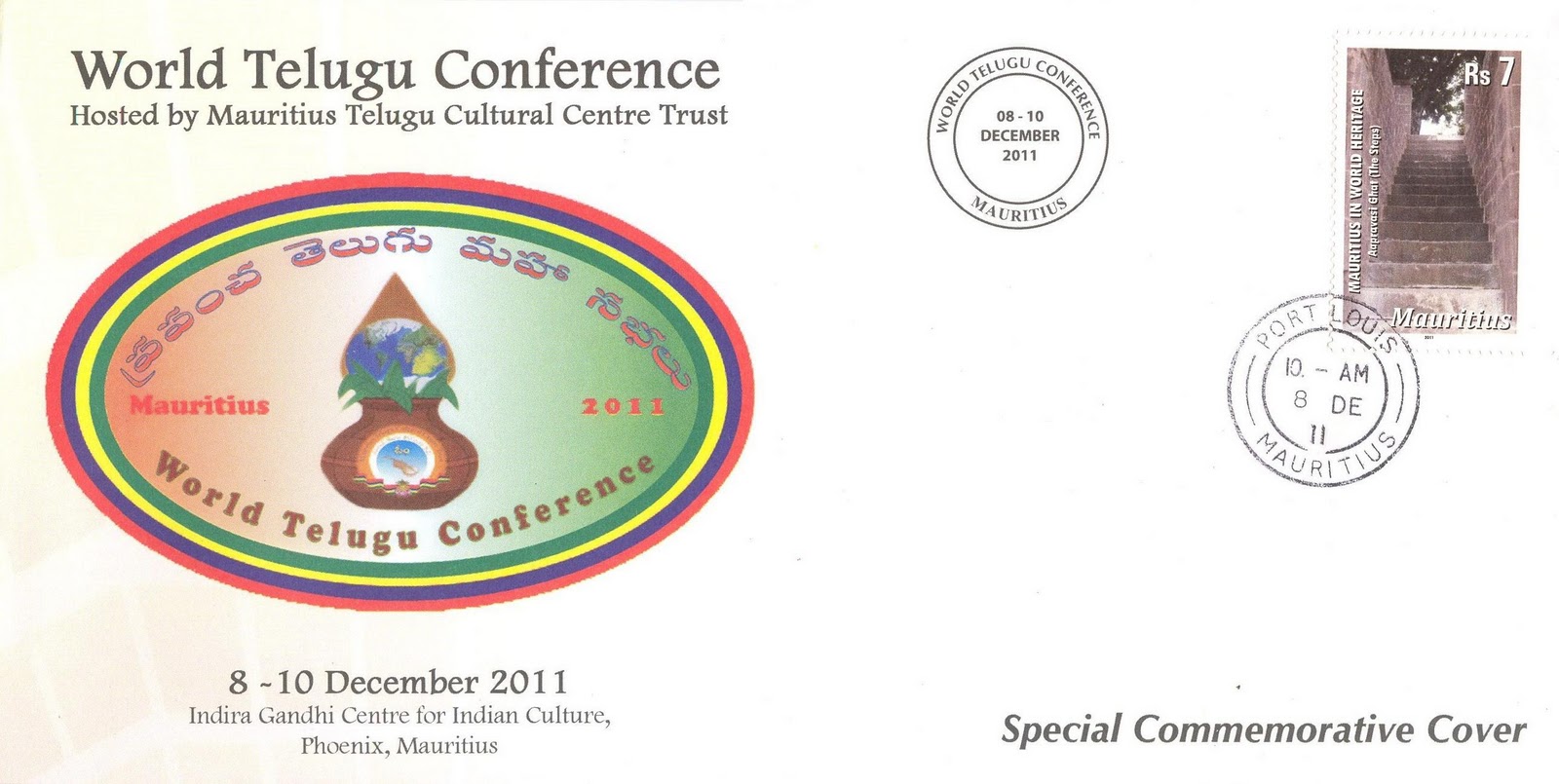
World Telugu Conference


The Mauritius Telugu Cultural Centre Trust along with the Mauritius Andhra Maha Sabha and the Telugu Speaking Union are hosting a World Telugu Conference in Mauritius from 8 to 10 December 2011.

Telugu as a language is of Dravidian origin, borrowing heavily on Sanskrit.  During the middle ages the word Andhra became synonym with Telugu and Tenugu.

Telugu is the second largest spoken language in India after the Hindi.  It is also the mother tongue for several Telugus living outside Andhra Pradesh and India.


The last World Conference organised in Mauritius was in December 1990.  Since the first World Telugu Conference in April 1975, the Government of Andhra Pradesh has not organised any conference either in Andhra Pradesh or outside except for the one in Malaysia in 1981.

The 2011 conference is being held at the Srimathi Indira Gandhi Centre for Indian Culture located at Phoenix.  The subject for discussions will be on language, culture, traditions, arts and music.  Eminent personalities have been invited to make presentations.

Technical details:
Event: World Telugu Conference
Release date: 8 December 2011
Cover illustration: 2011 Conference Logo
Stamp: Rs7 (Aapravasi Ghat) of the Mauritius in World Heritage issue (2011)

Tuesday, December 6, 2011

60th Anniversary of Petrusmok


Petrusmok is the most revolutionary book ever written by Mauritian author Malcolm de Chazal.  This masterpiece of 580 pages was penned in 170 days between July 11 and December 28, 1950!

In Petrusmok, Malcolm de Chazal reads through the strange sculpture of the mountains of Mauritius the signs of a mythical past, that of the lost continent of Lemuria.  According to legend, these mountains of Lemuria have been carved by a race of giants whose descendants still inhabit the island and have a language based on the analogy and correspondence.  The carcasses of giant trees and fossils constituting, for the inspired Petrusmok, the obvious remains of this civilisation.  That is what gives the Mauritian collective memory enough to feed his imagination for years to come, the myth giving up the fable to become the collective thought of an ancient people.

An extract from Petrusmok...

Sixty years later, this book still keeps its strength and is still a source of poetry giving another glimpse of the insular reality of Mauritius.

Technical Details:
Event: 60th Anniversary of Petrusmok (1951-2011)
Release date: September 12, 2011
Cover illustration:  Portray of Malcolm de Chazal (1902-1981) + Quote: "Jamais le poète n'est plus vivant que  quand il est mort."
Stamp: Rs7 (Corps de Garde) of Mountains issue (2004)

Saturday, December 3, 2011

Birth Centenary of Seewa Bappoo


The Mauritius Post is issuing a Special Commemorative Cover to commemorate the birth centenary of Hon. Seewa Bappoo.

Mr. Bappoo was born on November 10, 1911 in Vacoas, the eldest of 8 children to Mr. and Mrs. Ramchandar Bappoo.  His grandparents were both from Ratnagiri, in Maharashtra, India.

He was educated at the Church of England School in Phoenix and at the Curepipe Boys' School, and then completed his secondary education at the Royal College of Curepipe.

Mr. Bappoo was a keen philatelist and a lover of nature, mostly of the sea world.  He was also passionate about roses, especially blue ones.

From November 1963 to November 1976 he was a Member of the Legislative Assembly, and from 1974 to 1976 was appointed Parliamentary Secretary until he retired from politics.

In 1965, Bappoo attended the London Constitutional Conference at Lancaster House, which paved the way for independent Mauritius.

In his maiden speech in December 1963, he said "that independence will come as a natural step in the development of any upsurge country.  To get our independence we must show ourselves up to standard, as we are far from facts that everyday proved our political maturity.  We must be determined to goive every citizen his freedom and employment, by helping the enlargement of various industries, helping the creation of new ones, facilitating the industrial, agricultural and economic development of Mauritius and eventually a real industrialisation of Mauritius.  We sincerely hope that we will help towards the progress and prosperity of this country, the pearl of the Indian Ocean."

In 1981, he was awarded the Order of the British Empire (OBE) by the Queen Elizabeth II for his cultural involvement in the Marathi community in Mauritius and his political contributions from 1963 to 1976.

The late Honourable Seewa Bappoo passed away on March 3, 1992 at the age of 80.

Technical details:
Event: Birth Centenary of Honourable Seewa Bappoo, O.B.E.
Release date: December 3, 2011
Cover illustration: Portray of Seewa Bappoo, Underwater View & the 4 Colours of the Mauritian Flag
Stamp: Rs8 (fish repopulation) of the Ecology issue (2006)

Thursday, December 1, 2011

HIV & AIDS Awareness

Today being World AIDS Day, I take this opportunity to share with you this FDC released by the Mauritius Post on October 9, 2011 in the context of World Post Day and to commemorate the 30th Anniversary of the Discovery of the Virus of AIDS.


Mauritius has an estimated HIV prevalence of 0,97% among the adult population, of which 5030 cases are known according to July 2011 statistics.  An average of 35 new cases of HIV are being registered every month.  20% of the affected population are women.

First Day Cachet...

The epidemic in Mauritius is driven by injecting drugs and is of a concentrated nature with prevalence as high as 47.4% among injecting drug users, 28.9% in commercial sex workers and 8.1% in men having sex with men.


To address the epidemic, the National HIV and AIDS Stategic Framework 2007-2011 is being implemented.  It is geared towards universal access to prevention, care & support, with a particular attention to the prevention of new infection amongst our Most At Risk Populations.

Unofficial FDC...

Harm Reduction Programmes, namely the Needle Exchange Programme and the Methadone Substitution Programme for injecting drugs users have been put in place to contain the epodemic among people who inject drugs.  Treatment facilities are decentralised in regional hospitals and anti retroviral therapy is provided free of charge to people living with HIV.

Special World Post Day handstamp...

Prevention being the only vaccine against HIV, information, education and communication campaigns are ongoing at community level and in the media.  An HIV and AIDS Act was passed in 2006 in order to provide a legal framework for the prevention and treatment of HIV, to protect the rights of people living with HIV and AIDS, and to eliminate all forms of discrimination against them.

... and World Post Day date stamp.

A multi-sectoral approach has been adopted to fight HIV in the country.  The response engages in Government, NGOs, civil society and the private sector, and is led by the National AIDS Secretariat based in the Prime Minister's Office.

Cancelled-to-order block of four


"Let us fight HIV,
not people living with HIV."

Technical Details:
Release date:  09 OCT 2011
Designer: Nitish Peechen
Illustration: National HIV/ AIDS Logo
Printer: BDT Intl. Security Printing Ltd.
Process: Lithography
Size: 29.94 mm ×44.45 mm
Number per sheet: 50 stamps set in two panes of 25
Perforation gauge: 14 × 2 cm
Gum: PVA
Courtesy: National AIDS Secretariat (Prime Minister's Office)
                Prévention Information Lutte contre le Sida (PILS)

Saturday, November 26, 2011

International Commemorative Events 2011

The Mauritius Post released on September 8, 2011 a set of 3 stamps to celebrate international (scientific) events.  It was the first time ever that stamps of denominations Rs11 & Rs17 were issued.


Rs11 - 250th Anniversary of the Observation of the Transit of Venus from Rodrigues
Mauritius takes pride in having been associated (concurrently with 61 other sites of observation around the world) with the astronomical study of the Transit of Venus on June 2, 1761.  The 'Académie des Sciences' sent a team headed by French scientist and Clergyman Cannon Alexandre-Gui Pingré for this observation in the island of Rodrigues.

In spite of the unpredictable climatic conditions, the mission was successful.  Pingré observed the track of Venus over the disk of the Sun and the distance of Venus to the border edge of the sun, with a micrometer applied to the bezel of 18 foot.  At the same time, a member of his team observed the passages from the edges of the Sun and Venus by a wire horizontal and vertical of a quarter-circle.

 In his report submitted to the 'Académie des Sciences', Clergyman cannon Pingré described the methodology used to define the observations of the parallax of the Sun.  From the observations made in Rodrigues in 1761 and those of 1769 in Saint Domingue (Caribbean region), he calculated the distance of the Sun to be of 92,796,950 miles which is only at 0,17% of the estimated distance of 92,956,038 miles.

The ecliptic conjunction of the Venus and the Sun lasted for 6 hours.


Rs12 - International Year of Chemistry
The International Union of Pure and Applied Chemistry in conjunction with the UN and UNESCO have proclaimed the year 2011 to be the International Year of Chemistry (IYC 2011).  The goals of IYC 2011 are to increase public appreciation of chemistry, to encourage interest in chemistry among young people and to generate enthusiasm for the creative future of chemistry.

2011 coincides with the centenary of the Nobel Prize awarded to Marie Curie and this is an opportunity to celebrate the contributions of women to Science.  This year also marks the centenary of the founding of the International Association of Chemical Societies, providing a chance to highlight the benefits of international scientific collaboration.

The stamp illustrates chemists at work and on the right Mendeleev's Periodic Table and the chemical formula for water, H2O.


Rs17 - International year of Forests
The UN General Assembly has proclaimed 2011 as the International Year of Forests which conveys the theme of  "Forests for People".  It celebrates the central role of people in the sustainable development of our world's forests.  The Forests and Reserves Act No.41 of 1983 caters for the protection and management of state forests and reserves.

The forests of Mauritius were once abundant sources of valuable timber and this situation led to the decimation of most of our indigenous forest during early colonisation.  Today, less than 2% of the total surface area of Mauritius is still occupied by native forest.  However, in an attempt to conserve and reforest degraded land, the Forestry Service, in collaboration with other institutions are actively involved in the conservation and restoration programs to recreate the pristine ecosystems.

The stamp shows a native forest in Mauritius.

Technical Details:
Release date - September 8, 2011
Designer - Nitish Peechen
Printer - BDT International Security Printing Ltd.
Process - Lithography
Size - 29.94 mm × 44.45 mm
Perforation gauge - 14 × 2cm
Gum - PVA
Sheet format - 50 stamps set in two panes of 25

Friday, November 25, 2011

Anniversaries and Events 2011

The Mauritius Post issued on June 30 last a set of 4 stamps to commemorate various Anniversaries and Events for the year 2011.


Rs7 - Population Census
The 18th population census was carried out in the Republic of Mauritius from  20 June to 31 July 2011 by the Central Statistics Office.  At the census, everyone is asked the same questions on the same day (the Census Night) to produce a unique set of facts and figures about the nation.  The Census Night was fixed on 03-04 July 2011.

Besides telling how many people live in the Republic and their characteristics, the census provides baseline information to determine what types of services they need now and are likely to need in the future.  It helps the Government and local authorities to allocate funds, decide future policy and plan important services such as transport, housing, health and schools.

The population count in 1735 was around 800 inhabitants and in 2011, this number reached 1,303,717.  The stamp illustrates the census form of XIX century.

Rs14 - Birth Centenary of Sir Moilin Jean Ah Chuen (1911-1991)
Sir Moilin Jean Ah Chuen was born on February 22, 1911 in Port Louis and played a very active and significant role for more than 50 years in thecommerce and industry, and in the socio-economic, cultural and political development of Mauritius.

In 1948, Sir Moilin was elected President of the Chinese Chamber of Commerce of Mauritius.   He became captain of the Mauritius Home Guard Contingent, as part of the country's defense structure during the World War II.

Sir Moilin was also appointed as a Nominated Member of the new Legislative Assembly in 1948, was elected in the 1963 and 1967 general elections and became Minister of Local Government in 1969.

He was knighted by Queen Elizabeth II in 1980 in recognition of his immense contribution in the field of political and public services, and made Knight of St. Gregory by the Vatican in 1991.  The Rs25 banknote also bears his hand engraved portrait.


Rs21 - 125th Birth Anniversary of Dr. Maurice Curé (1886-1977)
Dr. Maurice Curé was born on September 3, 1886.  In 1921, Dr. Curé got involved in politics and in 1936, he showed his will to serve the working class, advocating for constitutional reforms and denouncing exploitation and injustice.

In the same year, he launched an island wide campaign appealing for unity among the workers which culminated ina public gathering meeting organised at the Champ de Mars and attended by around 30,000 workers.  This marked the foundation of the Labour Party.

The following year, Dr. Curé and other leaders of the party were imprisoned following a general strike which affected almost all the sugar estates of the country.  The Hooper Commission instituted after the general strike, highlighted the needs for reform in favour of the workers and paved the way for the establishment of Trade Unions and the creation of a Labour Department.

Dr. Curé continued to press for further political reforms.  He was nominated as a meber of the Legislative Council in 1946 and 1948 and of the Legislative Assembly in 1964.


Rs25 - Centennial of the Médine Sugar Estates
The Médine Sugar Estates Ltd. were established in 1911 as a sugar producing company.  The factory is located in the western part of the island in the district of Black River.  In 2010, the Médine Sugar factory has crushed 408,114.76 tons of sugarcanes for a production of 46,127.96 tons of sugar.

From a company engaged solely in sugar production, it has diversified its activities in the middle of the last century in livestock. cattle, stag rearing, vegetable cultivation, farming, leisure and property development.

The stamp depicts the Médine Sugar factory.

Technical Details:
Release date - June 30, 2011
Designers - Nitish Peechen & Neshvin Ramsawmy
Printer - Cartor Security Printing
Process - Lithography
Size - 27.94mm × 44.45mm (Rs7 & Rs25)
          44.45mm × 27.94mm (Rs14 & Rs21)
Perforation gauge - 14 × 2cm
Gum - PVA
Paper - CASCO Watermarked
Sheet format - 50 stamps set in two panes of 25

Saturday, November 19, 2011

Mauritius in World Heritage

The Mauritius Post Ltd. issued on April 18, 2011 a set of 4 postage stamps on the theme: "Mauritius in World Heritage".  The set comprises 2 stamps depicting Le Morne Heritage Site and 2 other the Aapravasi Ghat.


Rs14 & Rs15 Denominations: Le Morne Cultural Landscape
Le Morne is a mountainous promontory in the South West of the island of Mauritius where slaves escaping servitude found refuge.  Le Morne holds great importance in the history and memory of Mauritius.  It is known above all for its association with runaway slaves, engaged in their act of defiance against the system of slavery generally referred to as maroonage.  Le Morne stands out as a symbol where maroons paid a high price to retain their freedom by retreating into a dangerous mountain that required confronting frightening heights and negotiating narrow passes in hazardous conditions.  In extreme cases, maroons chose death over captivity.


This impressive natural site also symbolises the slaves' fight for freedom, their suffering and their sacrifice, all of which have relevance, beyond its geographical location, to the countries from which the slaves came - in particular Africa, Madagascar, India and South East Asia - and represented by the Creole community of Mauritius and their shared memories and oral traditions.

Slavery was officially abolished in Mauritius on the first of February 1835.  Commemorations are held in the island on that special date every year.  Le Morne Cultural Landscape was inscribed on the UNESCO World Heritage List in July 2008.

-The Rs14 stamp illustrates Le Morne Mountain and its surrounding landscape.
-The Rs15 stamp illustrates the monument, seen from the mountain, erected in the memory of the slaves and their country of origin.

Registered cover sent from SSR International Airport Post Office franked with the Rs7 and Rs14 denominations stamps

Rs7 & Rs25 Denominations: The Aapravasi Ghat
After the abolition of slavery, workers were desperately needed to work on the sugar cane estates as the majority of freed slaves refused to work in the fields again.  That is when the British administration decided to bring thousands of indentured workers from India, mainly, Eastern Africa, Madagascar, China and South East Asia.  Unlike slaves, indentured labourers were remunerated - though poorly - but there living conditions were not better.

The Aapravasi Ghat (meaning The Immigration Depot in Hindi) used to accommodate indentured labourers from the time of their landing to their deployment on the various sugar cane estates around the island.  The Aapravasi Ghat site stands as a major historic testimony of indenture in the 19th century.  It represents not only the development of the modern system of contractual labour, but also the memories, traditions and values that these people carried with them when they left their countries of origin to work in foreign lands.

The Aapravasi Ghat was inscribed on the UNESCO World Heritage List in July 2006.

-The Rs7 stamp depicts the flight of 16 steps which stands as the most symbolic figure of the site.  It marks the gateway through which thousands of indentured labourers hailing from diverse parts of the world first laid foot before going through the immigration process to seek another future.

-The Rs25 stamp features the hospital kitchen located within the hospital block and where medical instruments were sterilised.  Basic medical examinations of the indentured labourers were conducted in the hospital block.


The MPL also released a souvenir sheet consisting of the 4 stamps..

Technical Details
Date of Issue: 18 April 2011
Designer: Nitish Peechen
Printer: BDT Intl. Security Printing Ltd.
Process: Lithography
Size: 27.94 mm x 44.45 mm (Rs7 & Rs25)
        44.45 mm x 27.94 mm (Rs14 & Rs15)
Gum: PVA
Paper: CASCO Watermarked
Sheet Format: 50 stamps set in two panes of 25 with gutter
Miniature Sheet Size: 12cm x 10cm

Thursday, November 17, 2011

International Customs Day 2011

Hi everyone! I'm back! :)  A little Souvenir Cover to get started...  

This year the World Customs Organization has dedicated the theme "Knowledge, a catalyst for Customs excellence" to commemorate the International Customs Day celebrated on 26th January, 2011.  This is in tribute to the critical role knowledge plays in enhancing the effectiveness and efficiency of Customs administrations across the globe.


In Mauritius, International Customs Day 2011 coincided with the official relocation of the Customs department under one roof at the Customs House.  The year 2011 also marks a significant landmark in the history of the department.  Though according to the Mauritius Archives, a Bureau des Douanes (Customs Office) was set up in 1797, the present department dates back to 1811 with the British takeover and the nomination of Christopher Teesdale as first Collector of Customs.  The nature and function of the institution was significantly transformed in the 19th century with the department operating as a typical Custom House of the British Empire.

The department has played a significant role in the country's development, not only as a revenue raising institution, or in business facilitation but also in maintaining public health through the prohibition of imports of dangerous drugs, narcotics and other substances, in the control of pests and animal diseases as well as in wild life preservation through exports prohibitions.  It also played an ever increasing role in safeguarding the intellectual property rights.

Letter from first Collector of Customs in Mauritius, Christopher Teesdale.

In 2004, The Mauritius Revenue Authority (MRA) was established as an agent of the State for the management, operation and administration of Revenue laws. MRA became fully operational with effect as from the 1st July 2006 and it integrated the Customs department in a unified revenue collecting structure.

The Customs department has moved to a new and state of the art building at Mer Rouge.  Through its architectural design and organizational set up, the Custom House symbolizes a commitment to modernity and enhancement of knowledge.  It houses a modern training school and a fully equipped documentation centre/ library.  The new building will also house a small museum retracing the history of Customs in Mauritius from the colonial era to the post-independence period.

Technical Details
Event: International Customs Day
Release Date: 26 January 2011
Design: Nitish Peechen
Cover Illustration: New Customs House, Mer Rouge
Stamp: Rs7 of the Bicentenary of the British Conquest of Isle de France issue (2010)